Which of the Following Periods Saw the Development of Early Western Medieval Art?
Early Medieval: Art
The Anglo-Saxon menstruum produced highly distinctive art of earth-class significance, from the sumptuous metalwork of Sutton Hoo to the glorious illuminations of the Lindisfarne Gospels and the ballsy poem Beowulf.
METALWORK
Craftsmanship in metal was highly valued by the offset Anglo-Saxon settlers. Many early on examples survive in the excavated brooches used specially by women to fasten and adorn their clothing.
Even more outstanding metalwork, sumptuously engraved and colourfully inlaid, appears among the astonishing treasure found with the imperial 'send burial' of the 620s at Sutton Hoo in Suffolk. Most impressive of all is a solid gold belt-buckle decorated with patterns of interlaced snakes, showing that such patterns are not, equally often at present described, purely Celtic.
A similarly rich hoard of mid-7th-century metalwork found in Staffordshire demonstrates that such riches and exquisite workmanship were non confined to the kingdom of Due east Anglia.
CHRISTIAN Art
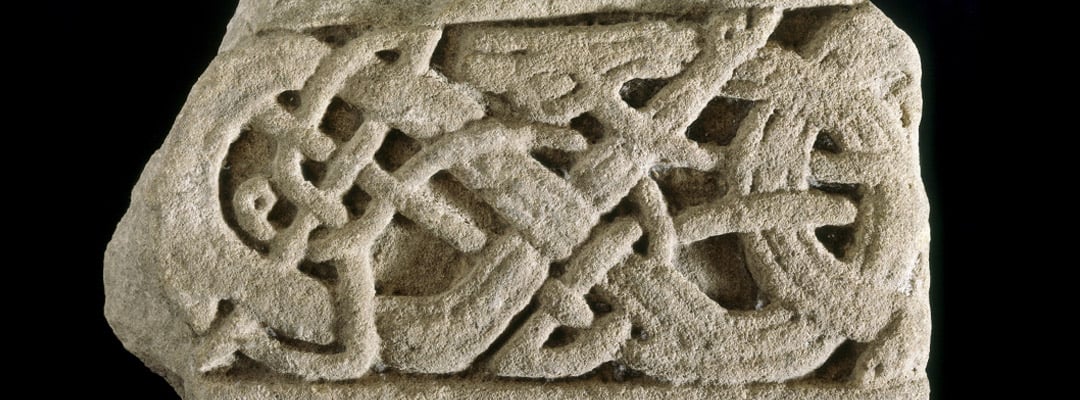
'Interlace' is as well a distinctive characteristic of seventh- and eighth-century illuminated Christian manuscripts. Some of the best known were produced in Northumbrian monasteries, including Lindisfarne Priory. The Lindisfarne Gospels, with their gorgeous 'carpet pages', were produced at that place in the early 8th century.
Past nearly 700 English language art was substantially Christian fine art, and it was also manifested in sculpted stone 'high crosses'. Combining interlace patterns with Christian imagery, some – like the ninth-century Cheshire Sandbach Crosses – were originally painted equally well every bit carved. Others made after, under the influence of Viking/Scandinavian patrons, integrate infidel motifs.
The magnificent 8th-century cantankerous at Ruthwell (in one case part of the kingdom of Northumbria, but now in Scotland) incorporates what may be the oldest surviving fragment of Anglo-Saxon verse, part of a Crucifixion poem called the Dream of the Rood.
Poetry
The earliest English poetry was probably not written downwardly at all, only memorised for declamation to a harp accessory. The famous epic poem Beowulf, which survives in a single manuscript made in most thou simply describes much earlier events, begins with a shout for silence in the 'mead-hall'.
It besides depends for its outcome on 'heard' rather than read devices like strings of alliterating words, and on ingenious synonyms – so 'the swan's bath' is the sea.
The commencement English language poet whose proper noun we know is Cædmon, a humble lay-brother at Whitby Abbey in Abbess Hild'south time (657–80). According to Bede, he was of a sudden granted divine power to etch religious verse in English language.
Bede's ain Ecclesiastical History of the English language People (731) was written in Latin, the universal language of learning. But 150 years later, scarcely anyone in England could write or even understand it – or so King Alfred claimed.
REVIVING A CULTURE
King Alfred of Wessex (r.871–99) set out to rebuild learning in English rather than Latin following the wholesale destruction of English art and civilization that occurred during the mid-ninth-century Viking depredations.
The king himself was involved in translating basic Latin works into English which he considered 'necessary for all men to know', sending copies to every English language bishopric. The Alfred Jewel, a masterpiece of English language metalwork, is probably the handle of one of the precious word-pointers he sent with them. Alfred's utilise of the spoken vernacular (English) language rather than Latin for scholarly works was an innovation, enabling it to develop every bit a written linguistic communication much before than other European languages.
And English language art did revive, despite the further Viking raids which gave rise to the Battle of Maldon (991), the most moving of the old-style heroic poems. Amidst the revived culture's glories was opus anglicanum ('English work') embroidery, recognised as the finest in Europe (the Bayeux Tapestry represents the apogee of this tradition), and a new 'Winchester Fashion' of illuminated manuscripts.
Now in far closer contact with western European networks, the art of Anglo-Saxon England was still flourishing at the time of the Norman Conquest.
More about Early Medieval England
-

Early Medieval: Compages
Virtually early medieval buildings were synthetic mainly using wood, merely this tradition left its marking on afterward rock-built churches.
-

Early Medieval: Art
The early medieval period produced many examples of highly distinctive art of globe-class significance.
-

Early on Medieval: Networks
Between the cease of Roman rule and the arrival of the Normans, England'south relationship with the wider world changed many times.
-

Early Medieval: Power and Politics
This catamenia saw the evolution of a nation of warlords into a country organised into distinct kingdoms.
-

Early on Medieval: Organized religion
Christianity in Uk tends to be associated with the arrival of St Augustine in 597, simply information technology had in fact already taken root in Roman Britain.
Early on Medieval Stories
-

The Viking Raid on Lindisfarne
A devastating Viking assail on the church building of St Cuthbert in 793 sent a shockwave through Europe. Only how did a Christian community at Lindisfarne survive?
-

Who Was St Augustine?
In the late 6th century, a man was sent from Rome to England to bring Christianity to the Anglo-Saxons. Only who was St Augustine, and how did his mission succeed?
-

Caedmon, Whitby and Early English Poetry
How Cædmon's poetic awakening, at the monastery that lies beneath Whitby Abbey, produced one of the first fragments of English language verse.
-

Queen Bertha: A Historical Enigma
In 597, St Augustine arrived in England to catechumen the Anglo-Saxons to Christianity. Near every modern description of this mission mentions Queen Bertha of Kent. But who was Bertha?
-

The Synod of Whitby and the Keys of Heaven
How a decision about the way in which the appointment of Easter should be calculated was a landmark in the history of Christianity in England.
-

St Hild of Whitby
Hild is a significant figure in the history of English Christianity. As the abbess of Whitby, she led one of the most important religious centres in the Anglo-Saxon globe.
-

Two Happy Accidents Reveal Odda's Chapel, Deerhurst
How the adventure discovery of a chapel in Gloucestershire has proved crucial to our understanding of Anglo-Saxon compages.
Source: https://www.english-heritage.org.uk/learn/story-of-england/early-medieval/arts-and-invention/
0 Response to "Which of the Following Periods Saw the Development of Early Western Medieval Art?"
Post a Comment